



Car accidents don’t wait for business hours. They happen on highways, neighborhood streets, and intersections at random times of the day. The moment after a crash, many people don’t remember a TV commercial, a billboard, or a bus ad. They grab their phone, open Google, and type “car accident lawyer near me” or “injury lawyer in [city]”. The firms that win those searches, win the client.
That’s exactly where Local SEO comes in. For car accident and injury lawyers, Local SEO isn’t just “another marketing channel” — it’s the bridge between a person in crisis and your intake team. If your firm doesn’t appear in Google Maps, the local 3-pack, and organic local results, someone else will become the “first call” after a crash.
1. Why Local SEO Is Different for Car Accident & Injury Firms
Not all legal practice areas behave the same way online. Car accident and injury law has three very specific characteristics that make Local SEO absolutely critical:
-
High urgency: People search immediately after a crash or once they realize the insurance company is not helping. They don’t have weeks to “research law firms”; they choose from the first credible options they see.
-
Location-sensitive intent: Almost no one searches “injury lawyer” alone. They search “car accident lawyer near me”, “auto accident attorney [city]”, “injury lawyer [highway name] crash”, or similar.
-
Mobile-dominated behavior: The majority of these searches happen from a smartphone, often at the scene of the accident, at the hospital, or in a parking lot.
This means that if you’re not visible locally, your amazing verdicts, office, and experience are basically invisible when it matters most. Traditional SEO tries to rank your site “everywhere”; Local SEO focuses on making you the obvious choice in your city, county, and neighborhoods.
2. How Real People Actually Search After a Crash
Let’s walk through the real-world behavior of someone who’s just been in a car accident. This is the reality Local SEO must match.
A typical sequence looks like this:
-
They get into a collision on a busy road or intersection.
-
After the initial shock, they make sure everyone is safe and call the police if needed.
-
While waiting, they start worrying: “What about the car? Medical bills? Lost wages?”
-
They unlock their phone and search something like:
-
“car accident lawyer near me”
-
“car accident attorney [city name] free consultation”
-
“hurt in car crash what to do [city]”
-
-
If they’re at home later, they might search from the couch:
-
“insurance not paying after car accident”
-
“should I get a lawyer after rear end collision”
-
In all of those scenarios, Google responds with local results: the Map Pack, a list of nearby law firms, and review scores. The firms with strong Local SEO show up first, with clear contact info, strong ratings, and persuasive content.
If your firm isn’t in that local mix, you’re not “in the game” in the moments that matter.
3. Google Maps, the Local 3-Pack, and Why They Matter
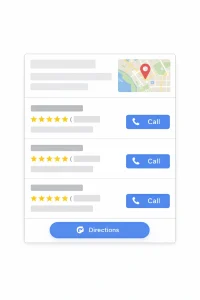
When someone searches “car accident lawyer near me”, one of the first things they see is the Google Maps 3-pack (also called the Local Pack):
-
A small map of the area
-
Three highlighted law firms with ratings, number of reviews, phone, and directions
For car accident and injury lawyers, dominating this Local Pack is pure gold. Those top three listings get a huge share of calls and clicks. To show up there consistently, your Local SEO needs to be laser-focused on a few key elements:
3.1. Optimize and fully build out your Google Business Profile
Your Google Business Profile (GBP) is the foundation of Local SEO. At minimum, your GBP should have:
-
Accurate Name, Address, Phone (NAP), https://support.google.com/business/answer/3038177?hl=en&utm_source=chatgpt.commatching your website and directories
-
Primary category: “Personal injury attorney” (or equivalent, depending on your jurisdiction)
-
Secondary categories if appropriate (e.g., “Law firm”, “Trial attorney”)
-
Business hours, including after-hours or 24/7 call-answering if you have it
-
Website URL pointing to a relevant landing page (often your car accident practice page)
-
Short, keyword-rich business description mentioning car accident, auto injury, and your city/area
Every detail is a signal to Google: this firm serves people injured in car accidents in this specific location.
3.2. Add photos that reflect real car accident/injury clients
People scrolling results want proof of real life, not generic stock photos. Add:
-
Pictures of your office exterior and interior (so people recognize it when driving there)
-
Photos of your team meeting with clients (with consent)
-
Images of your intake area and conference rooms
These visuals help searchers feel like your firm is real, local, and approachable — especially in a stressful moment after a crash.
3.3. Use Google Posts and Q&A
For car accident and injury law, Google Posts and the Q&A section are underrated assets. You can:
-
Post short updates like “What to do after a car accident on [Highway Name]”
-
Answer common questions such as “Do I need a lawyer if the accident wasn’t my fault?” or “How much time do I have to file a claim in [state]?”
This content aligns perfectly with the moment of intent and reinforces your Local SEO relevance.
4. Turning Reviews into Local Proof of Results
In injury law, trust is everything. People are about to tell you personal details about their health, finances, and family situation. Reviews become your public record of results and client experience.
For Local SEO, reviews are not just social proof — they’re ranking signals. Google looks at:
-
Average rating (e.g., 4.7 vs 3.2 stars)
-
Number of reviews compared to other firms in your area
-
Freshness of reviews (recent feedback shows you’re actively handling cases)
-
Keywords inside reviews, like “car accident”, “rear-ended”, “insurance company”, “settlement”, and local place names
Here’s how a car accident firm can use reviews strategically:
4.1. Ask for reviews after successful car accident and injury cases
Build a process into your case close-out:
-
Once a case is resolved and the client is happy, your team politely asks for a review.
-
Provide an easy link to your Google profile.
-
Explain that their review helps other injured people find trustworthy help.
When clients mention details like “car crash on [Highway/Street Name]” and “they helped me with my neck and back injuries after the accident”, that language reinforces your local, car-accident-specific authority in Google’s eyes.
4.2. Respond to every review
Responding to reviews — positive or negative — signals that you care about clients and actively manage your practice. It also gives you a chance to naturally reinforce local and practice-area terms:
-
“Thank you for trusting our firm after your car accident on [Road Name] in [City].”
-
“We’re glad we could guide you through your injury claim and get you a fair result.”
Keep it natural, never stuff keywords, but don’t be afraid to mention relevant details once.
5. Creating Pages for Neighborhoods, Highways, and Local Crash Realities
One of the most powerful (and underused) Local SEO strategies for car accident and injury lawyers is building content that mirrors how people experience accidents in your area.
Most firms have a generic page like “Car Accident Lawyer [City]” — which is good, but not enough. The next level is creating hyper-local pages such as:
-
“Car accident lawyer near [Neighborhood Name]”
-
“Injured on [Highway Name] or [Interstate Number]? Know your rights.”
-
“What to do after a crash at [Busy Intersection / Landmark] in [City]”
These pages should:
-
Describe specific roads, highways, and intersections that locals recognize.
-
Mention common types of accidents there (rear-end collisions, multi-car pileups, intersection crashes, drunk driving accidents, etc.).
-
Explain local procedures: which police department usually responds, nearby hospitals or urgent care clinics, typical traffic patterns.
-
Provide clear calls to action: phone number, click-to-call on mobile, and short form for consultation.
By doing this, you’re telling Google:
“We are not just ‘some injury firm’. We help people injured in car accidents on these actual roads, in these real neighborhoods, in this specific city.”
That level of relevance is a huge Local SEO advantage.
6. Building Content Around Urgent Questions from Injured People
Beyond your location pages, you need content that answers real questions from injured people, not just what the firm wants to say. This content is a Local SEO engine because it:
-
Attracts long-tail searches (“How long after a car accident can I claim in [state]?”).
-
Demonstrates expertise and helpfulness — which users and algorithms both reward.
-
Offers internal linking opportunities to your main car accident and local pages.
Some high-impact content types for Local SEO in car accident & injury law include:
6.1. “What to do after a car accident in [City/State]” guides
These should be step-by-step, written in clear language, and adapted to local realities. Include:
What to do at the scene (photos, exchanging information, calling police).
When medical attention is critical — even if injuries seem “minor”.
The basics of reporting to insurance.
When and why to call a car accident lawyer in [City].
Use bold text for crucial instructions, such as “Don’t admit fault at the scene” or “Get checked by a doctor even if you feel fine.”
6.2. FAQs about car accident and injury cases
Build out FAQ sections and standalone FAQ pages answering specific questions like:
-
“Do I need a lawyer after a minor car accident?”
-
“How are pain and suffering calculated in [state]?”
-
“What if the other driver doesn’t have insurance in [state]?”
-
“How long does a car accident claim take?”
These questions often include your location and tie directly into Local SEO queries, especially when you mention local courts, deadlines, and state-specific rules.
6.3. Insurance and settlement content
Real clients spend a lot of time searching for insurance-related information, for example:
“Insurance won’t pay for my car accident medical bills”
“Low settlement offer from insurance after car crash”
By writing content that explains:
-
How insurers typically respond in your state
-
When an offer is likely unfair
-
How an attorney can intervene
…you’re aligning your content strategy with how injured people think and search, which directly supports Local SEO.
7. Local Links, Directories, and Legal Listings
Local SEO isn’t only about what happens on your site or Google Business Profile. Off-site signals matter too — especially for car accident and injury lawyers in competitive markets.
Three key buckets are:
7.1. Legal directories
Make sure your firm is properly listed (with consistent NAP) in major legal platforms such as:
-
Avvo
-
Justia
-
FindLaw
-
Super Lawyers
-
Local bar association directories
Optimize each profile with car accident and personal injury focus, your city/metropolitan area, and links to the most relevant pages on your site.
7.2. Local business and community directories
Beyond legal sites, look at:
Chamber of Commerce directories
Local business associations
Community or neighborhood websites
These links and citations tell Google: this firm is genuinely based in and serving this area.
7.3. Local PR and community involvement
When your firm:
-
Sponsors local events
-
Supports safe-driving campaigns
-
Donates to trauma or rehab organizations
…look for natural mentions and links on local news sites, blogs, and nonprofit pages. These locally relevant links are incredibly powerful for Local SEO because they connect your brand to the car accident reality of your community.
8. Making Your Site Mobile-First for On-the-Scene Searches
Imagine someone at the side of the road, injured, looking up your site from their phone. If your website loads slowly, is hard to use, or hides the phone number, they’ll bounce.
For car accident and injury lawyers, mobile usability is not optional — it’s core to Local SEO success. Focus on:
-
Fast load times, especially on 4G or weaker connections
-
Click-to-call buttons fixed at the top or bottom of the screen
-
Simple, short contact forms (name, phone, quick description)
-
Large, readable fonts and clear headings
-
No clutter, no endless popups, especially for mobile users
Google looks at user behavior — if mobile visitors stay, click, and convert, it reinforces that you’re a strong result for those local car accident searches.
9. Tracking What Actually Works (So You Can Double Down)
Local SEO is not “set and forget”. You’ll want to track what’s working so you can make smarter decisions. For car accident and injury firms, good tracking means:
Using call tracking numbers that still keep NAP consistent (e.g., main number on GBP and directories, call tracking on landing pages).
Setting up Google Analytics 4 (or your preferred analytics tool) to track:
-
-
Phone call clicks
-
Form submissions
-
Live chat interactions
-
Monitoring which keywords and pages drive leads like:
-
-
“car accident lawyer near me”
-
“injury lawyer [city]”
-
“rear end collision lawyer [city]”
-
Watching performance inside Google Business Profile Insights:
How many calls you receive
How many people request directions
Which queries show your firm
Then, you can double down on what works:
-
Create more content around keywords that convert well.
-
Expand neighborhood and highway pages that bring in strong leads.
-
Invest in getting more reviews where visibility is high but reputation is still building.
10. Connecting Local SEO to Your Intake Reality
At the end of the day, Local SEO is only as valuable as the cases it brings in. For car accident and injury lawyers, that means Local SEO must be tightly connected to your intake and case selection strategy.
-
If your best cases are high-impact highway collisions, build more content and local pages around those highways, interstates, and typical accident patterns.
-
If you want more bike, pedestrian, or rideshare accident cases, create specific local pages and FAQ content for those scenarios.
-
Train your intake staff to ask, “How did you find us?” and log answers like Google Maps, Google search, found you after searching “car accident lawyer near me”. This creates a feedback loop that proves Local SEO value.
Local SEO is not just rankings. It’s a system that turns hyper-local online visibility into real people signing retainer agreements.
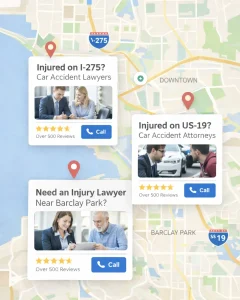
Be the First Name They See After a Crash
When someone’s day is shattered by a car accident, they’re not thinking about marketing strategies or algorithm updates. They’re thinking about pain, lost work, medical bills, and what happens next.
Local SEO is how your firm shows up right in that moment — on their phone, in their neighborhood, on the road where the crash happened. By:
-
Optimizing your Google Business Profile
-
Earning strong, authentic reviews from past car accident and injury clients
-
Creating hyper-local pages for neighborhoods, highways, and intersections
-
Publishing practical guides and FAQs that match real life after a crash
-
Building local links and directory consistency
-
Making your site fast and mobile-friendly
…you become the obvious, trusted choice when someone types “car accident lawyer near me”.
When the Road Turns Dangerous, Your Firm Should Be Easy to Find
That’s the real importance of Local SEO for car accident and injury lawyers: not just traffic, not just clicks, but being present at the exact moment when someone desperately needs a local advocate to fight for their recovery.