



Most injured clients don’t start by asking a friend. They grab their phone and type something like “car accident lawyer near me” or “injury attorney in Tampa” into Google. The law firms that appear in the map with star ratings usually get the first calls.
Local SEO is the work that helps your firm show up in those local searches. You don’t need to be a tech expert to understand it. You just need to know what it is, why it matters, and which simple actions move the needle.
What is Local SEO for Lawyers?
Local SEO (local search engine optimization) is the process of helping your firm appear when someone nearby searches for legal services. Traditional SEO tries to rank a website everywhere. Local SEO focuses on your city, county, or neighborhood, where your real clients live and work.
For example, imagine a person injured in a rear-end collision. They might search:
-
“injury lawyer near me”
-
“car accident attorney in [your city]”
-
“best personal injury lawyer [county name]”
Local SEO is what helps your firm show up in Google Maps, the Local Pack (the 3-map results at the top), and in organic results when those real-world searches happen.
The Map Pack: Why It’s Prime Real Estate
When you type “injury lawyer near me” into Google, you often see a map with three firms, star ratings, and phone buttons. That’s called the Local Pack or Map Pack.
For an injury firm, showing up there is gold. Clients can:
- See your name, phone, and reviews at a glance
- Tap “Call” directly from their phone
- Get directions to your office with one click
To appear there, Google looks mainly at three things:
-
Relevance – Does your profile clearly say you’re an injury lawyer, car accident lawyer, etc.?
-
Distance – How close is your office to the person searching?
-
Prominence – Do you have good reviews, complete information, and consistent listings across the web?
Local SEO is about improving what you can control in those areas.
Your Google Business Profile: The Foundation
Your Google Business Profile (GBP) is the free listing that powers your Maps and Local Pack presence. Think of it as your online business card inside Google.
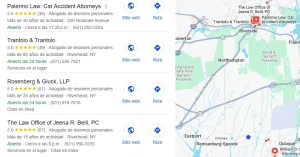
Some key elements for a law firm:
-
Business name: Use your real firm name (no keyword stuffing).
-
Primary category: For example, “Personal injury attorney” or “Law firm.”
-
Phone and address: Accurate NAP (Name, Address, Phone).
-
Practice areas: Add services like “Car accident lawyer,” “Slip and fall lawyer,” “Truck accident attorney.”
-
Photos: Upload real photos of your office, team, and reception—not stock models.
-
Hours: Make sure business hours are correct, including weekends if you take calls.
A well-optimized GBP helps Google understand what you do and who you serve, so it can match you to the right local searches.
Why Reviews Matter So Much
For an injured person who doesn’t know any lawyer personally, reviews are social proof. They answer two questions:
-
Can I trust this firm?
-
Do they get results and treat clients well?
Google also uses reviews as a signal for rankings. More high-quality, recent reviews can help you stand out in the Map Pack.
Simple review process you can start this week:
-
After closing a case, have your staff send a short email or text with your Google review link.
-
Use plain language: “If you found our help valuable, would you mind leaving a quick review so other injured people can find a lawyer they trust?”
-
Never write reviews for clients or offer money for a positive review (that’s risky and unethical).
The goal is steady, authentic reviews over time—not 20 in one day and then nothing for a year.
Legal Directories and Local Citations
Local SEO also looks at citations—mentions of your firm’s name, address, and phone across the web. For lawyers, this includes:
-
Legal directories: Avvo, Justia, FindLaw, Super Lawyers, and others directories for lawyers.
-
Local bar association directories
-
Local business directories: Chamber of commerce, city business listings, Better Business Bureau
For example, if your firm is “Smith & Jones Injury Law” in Tampa, your NAP should be exactly the same on your website, Google Business Profile, Avvo, Justia, and your local chamber listing.
Why consistency matters:
- It helps Google trust your business information.
- It reduces confusion for clients trying to contact you.
- It makes your firm look established and real.
A practical first step is to make a list of your major profiles and check that all of them have the same name, address, and phone number.
Turn Local Searches into Real Cases
Local SEO for lawyers is not magic or mystery—it’s showing up where injured people are already looking for help. By understanding the basics—Map Pack visibility, reviews, legal directories, and local content—you give your firm a better chance to be that first call after an accident.
Start small: clean up your Google Business Profile, fix your directory listings, and build one or two focused local pages. Step by step, you’ll build an online presence that matches the reputation you already have in the real world and turns local searches into signed cases.