Google Ads for Healthcare
How healthcare organizations can connect patient search intent, geographic relevance and the right landing-page experience with qualified calls, inquiries and appointment opportunities.
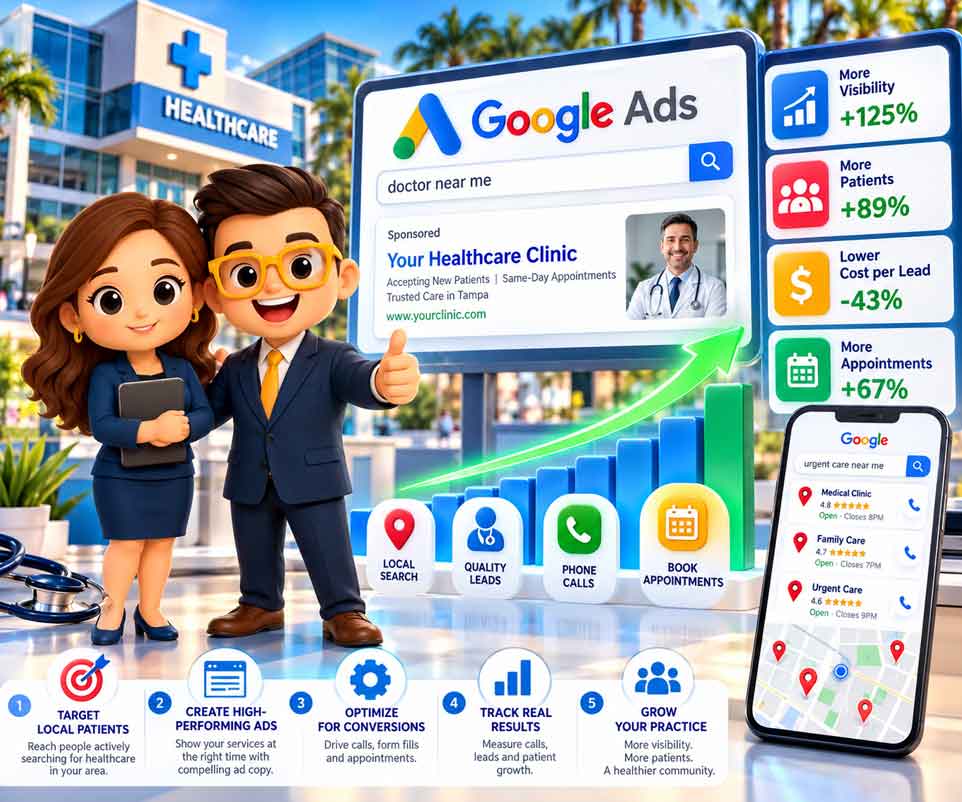
Google Ads for Healthcare can place a healthcare organization in front of people actively searching for a provider, service or appointment—but visibility alone does not create a qualified patient opportunity.
The campaign has to connect the person's actual search with the right healthcare service, appropriate geographic market, relevant information and a clear next action.
That distinction matters because someone researching general healthcare information is not necessarily at the same stage as someone searching for a provider nearby, comparing healthcare organizations or trying to schedule an appointment.
A strong healthcare campaign helps the right prospective patient move from search to a relevant answer and an appropriate next action.
What Is the Prospective Patient Actually Searching For?
Before building the advertisement, understand the problem, service, location and action behind the search.
The Most Important Part of Healthcare Google Ads Happens Before the Click
Consider a person searching Google for a healthcare service.
Before clicking an advertisement, that person may already have a specific need, geographic preference, concern, timing requirement or type of provider in mind.
The search query can provide important context about that intent.
The person appears to be searching for a local provider and may already be evaluating availability.
Location, availability and timing may strongly influence the decision.
The prospective patient has identified a type of healthcare service.
The person may be comparing providers before deciding whom to contact.
Google Ads Should Follow the Patient Journey
The prospective patient recognizes a healthcare need.
Google becomes one route for discovering providers or services.
The advertisement should correspond with the actual search intent.
They evaluate relevance, location and legitimate trust information.
Call, inquire or take an appropriate appointment action.
More Clicks Do Not Automatically Mean More Patients
One of the easiest mistakes in paid search is treating traffic as the final objective.
A campaign can produce impressions and clicks while still generating poor business results.
Did the Right Prospective Patient Find the Right Answer?
And after finding that answer, could the person understand what to do next without unnecessary friction?
The Landing Page Should Match the Search
If an advertisement promotes a specific healthcare service, sending everyone to a generic homepage can create unnecessary friction.
A relevant landing experience should quickly help the visitor understand:
- What healthcare service is being offered.
- Whether the service corresponds with the visitor's search.
- Where the provider or organization operates.
- How to take the appropriate next step.
- What legitimate information supports trust.
- Any important information or limitations relevant to the service.
Search Query → Ad → Landing Page → Action
| Search Intent | Advertising Direction | Landing Experience | Potential Next Action |
|---|---|---|---|
| Provider near me | Local provider relevance | Provider/service information | Call or appointment action |
| Specific healthcare service | Service-focused advertisement | Relevant service page | Contact / request information |
| Open today | Availability relevance when accurate | Location and accurate availability information | Call / appropriate next step |
| Local comparison | Clear differentiating information | Trustworthy provider information | Evaluate / contact |
Geographic Targeting Can Protect the Advertising Budget
Healthcare is often geographically dependent. Paying for traffic from people outside a practical service area can consume advertising budget without producing useful opportunities.
Geographic targeting should reflect the organization's actual locations, services and legitimate market—not an artificially expanded footprint created solely to attract additional searches.
Healthcare Advertising Requires Legitimate Trust
Trust is especially important when people are making healthcare decisions. The advertisement and landing page should use real, supportable information.
Do not invent credentials, certifications, reviews, patient outcomes, statistics, guarantees, experience or medical claims. Use only legitimate information the organization can support.
Healthcare Campaigns Should Be Built Around Qualified Actions
Determine whether the campaign is reaching searches connected with the healthcare services actually offered.
Evaluate whether advertising is reaching markets the organization can legitimately serve.
Make sure the post-click experience corresponds with the search and advertisement.
Measure appropriate calls, inquiries, appointment actions or other relevant outcomes rather than evaluating clicks alone.
Google Ads and Local SEO Are Different—but They Can Work Together
Paid search and organic search should not be treated as interchangeable.
Google Ads can provide paid visibility for selected searches while Local SEO develops the organization's organic search presence and geographic relevance.
For organizations where local discovery is important, the website, advertising strategy, organic content and legitimate business information should communicate a consistent picture.
Why Healthcare Businesses Should Not Depend Only on Paid Advertising
Paid advertising can be valuable, but its visibility is tied to campaign activity and advertising investment.
Organic search assets serve a different purpose by developing useful service content, technical quality, internal relationships and long-term discoverability.
This does not mean one channel automatically replaces the other. It means the organization should understand the role each channel plays in reaching qualified prospective patients.
Search → Intent → Relevant Answer → Trust → Next Action
Advertising should not begin with “How many clicks can we buy?” It should begin with “Who are we trying to reach, what are they searching for, and what useful next step should follow?”
Questions About Google Ads for Healthcare
Do Google Ads work for healthcare?
Google Ads can help eligible healthcare organizations reach people searching for relevant services. Results depend on market demand, competition, targeting, service fit, landing-page experience and campaign execution.
What is the main goal of healthcare Google Ads?
The objective should be meaningful business or patient actions—not clicks alone. Depending on the organization, that may include calls, inquiries or appropriate appointment actions.
Why am I getting clicks but not enough inquiries?
Possible causes include weak search intent, irrelevant queries, geographic mismatch, a poor landing-page experience, unclear calls to action or other conversion friction.
Should healthcare ads send traffic to the homepage?
Not automatically. When the advertisement addresses a specific service or need, a closely aligned landing page can provide a clearer experience than a generic homepage.
Should healthcare providers target “near me” searches?
Local-intent searches may be valuable when the organization actually serves that geographic market and the promoted service is relevant to the query.
Are Google Ads better than Local SEO?
They serve different functions. Google Ads provides paid search exposure, while Local SEO focuses on organic local discoverability. An organization may use one or both depending on its acquisition strategy.
Can Google Ads guarantee new patients?
No responsible marketer can guarantee a specific number of patients. Advertising can create qualified visibility and opportunities, but actual outcomes depend on multiple market and business factors.
What should a healthcare landing page include?
It should clearly explain the relevant service, geographic information, legitimate trust information and the appropriate next action while respecting applicable advertising, healthcare and privacy requirements.
How should healthcare businesses measure Google Ads?
In addition to impressions and clicks, evaluate search relevance, geographic quality, conversion actions, landing-page performance and the quality of resulting inquiries when reliable measurement is available.
Does website speed matter for healthcare Google Ads?
Website performance contributes to the post-click user experience. Slow or unstable pages can create friction before visitors understand the service or reach the next action.
Should every healthcare service use the same landing page?
Not necessarily. Distinct services can represent different patient needs and search intent. Dedicated pages can be appropriate when they provide genuinely distinct and useful information.
Can healthcare Google Ads target specific cities?
Geographic targeting can be configured around relevant markets, but campaign geography should correspond with the organization's actual service capabilities and applicable platform requirements.
Google Ads for Healthcare Should Connect Advertising With the Real Patient Journey
The strongest Google Ads for Healthcare strategy does not stop when someone clicks an advertisement.
It connects:
Search intent → appropriate ad → relevant information → legitimate trust → meaningful next action.
That is how paid search becomes part of a broader customer-acquisition strategy rather than simply another source of website traffic.
Paying for Clicks but Not Getting Enough Qualified Opportunities?
SMG Creativos can evaluate how your paid-search strategy connects search intent, targeting, landing-page experience and conversion opportunities to identify where the customer journey may be losing potential business.
Discuss Your Google Ads Strategy