Beginner Guide to Google Ads for Restaurant Marketing
A practical introduction for restaurant owners who want to understand how Google Ads can reach people searching for food, restaurants, reservations, takeout, delivery and dining options in their local market.
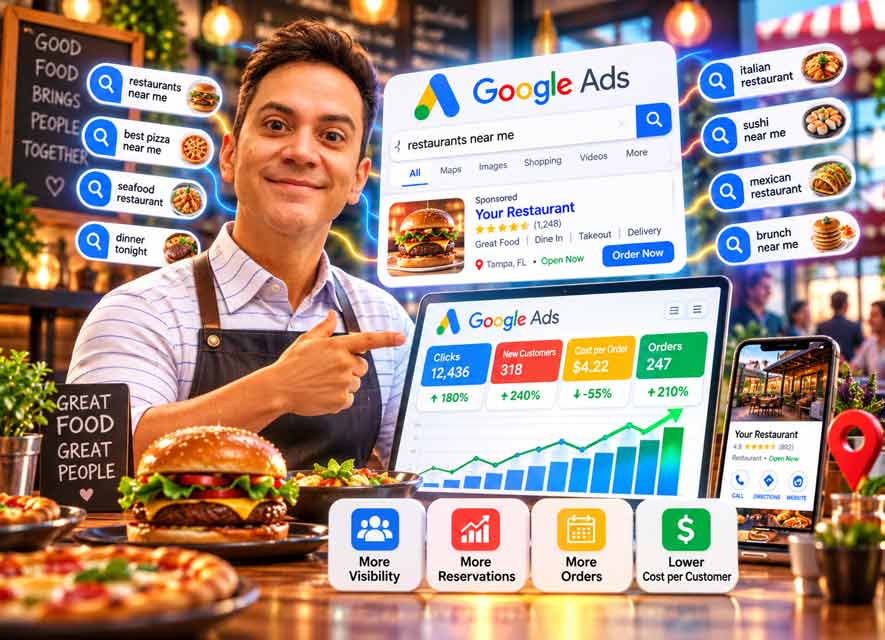
Google Ads for restaurant marketing can help a restaurant reach people while they are actively deciding where to eat, what cuisine they want, where to order food or which local restaurant to visit.
But launching a campaign does not automatically mean more tables, takeout orders or qualified customers.
For a beginner, the first thing to understand is simple: Google Ads purchases visibility. It does not purchase customer satisfaction, trust or guaranteed sales.
A restaurant can use Google Ads to compete for relevant searches from people looking for food or dining options. The restaurant selects targeting and campaign settings, Google can display eligible ads for relevant searches, and the restaurant pays according to the campaign and bidding model. Success depends on reaching the right searcher and giving that person a useful next step.
Start With the Customer, Not the Google Ads Dashboard
One of the easiest mistakes for a beginner is opening an advertising account and immediately thinking about keywords, budgets and buttons.
Start one step earlier.
Ask what your prospective customer is doing.
Are they searching for Mexican food near me? Are they trying to find a restaurant open tonight? Do they want takeout? Are they searching for a restaurant for dinner, lunch or a particular cuisine?
Those searches represent different intentions, and the advertisement should make sense for the intention behind the query.
What Is Your Customer Typing Into Google?
Watch how the search changes from general discovery to much stronger local dining intent.
Google Ads for Restaurants: The Beginner Process
Decide What You Actually Want the Campaign to Produce
“Get more customers” is too broad. Determine whether the campaign is intended to support restaurant visits, online orders, calls, reservations, directions or another measurable action that matters to the business.
Identify the Searches Closest to the Dining Decision
A person searching for a specific cuisine near them can represent a different opportunity from someone searching for recipes or general information. Beginner campaigns should understand this distinction before spending money on traffic.
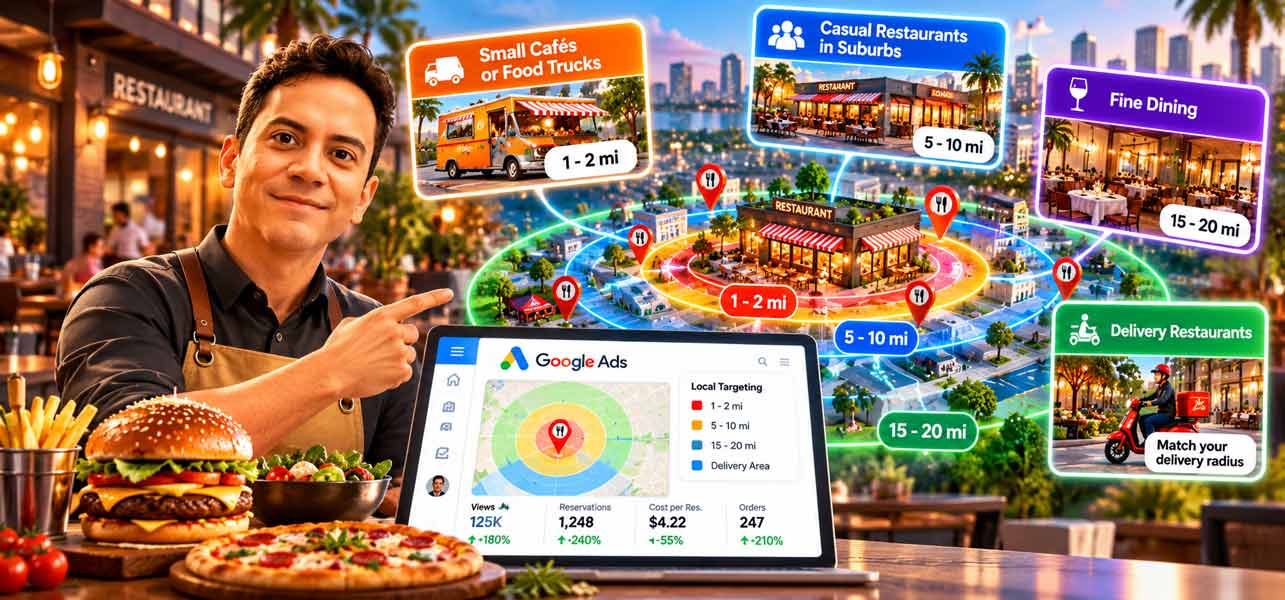
Advertise Where Real Customers Can Actually Visit or Order
Restaurants are highly geographic businesses. Targeting should align with the restaurant's legitimate customer market instead of paying for clicks from people who are unlikely to visit or order.
Build Around Relevant Restaurant Searches
Keyword strategy should reflect cuisine, dining intent, restaurant category, location and applicable services rather than chasing every phrase containing the word “food.”
Make the Advertisement Match the Search
If a person searches for a particular type of restaurant, the ad should clearly communicate why the restaurant is relevant. Avoid generic language that could describe virtually any restaurant.
Do Not Lose the Customer After Paying for the Click
The destination should quickly show the restaurant, cuisine, location and appropriate next action. Menus, directions, ordering information and legitimate restaurant details should be easy to find when relevant.
Track Business Actions, Not Only Clicks
Clicks and impressions explain advertising activity. They do not by themselves prove that the campaign generated restaurant customers. Track the meaningful actions appropriate to the campaign.
Review What People Actually Searched
Search-term analysis can reveal whether advertising money is reaching relevant restaurant searches or being consumed by queries that do not align with the business objective.
“I've Been Paying for Google Ads. Why Am I Still Not Getting Customers?”
Because purchasing traffic and acquiring customers are not the same thing.
The problem may exist in the search targeting, geographic settings, keyword strategy, advertisement, website, menu experience, offer, conversion tracking or somewhere else in the customer journey.
Google Ads should be evaluated as a complete acquisition path—not as a click counter.
Search Intent Matters More Than Beginners Often Realize
| Google Search | Likely Intent | Buyer Stage | Useful Experience |
|---|---|---|---|
| restaurants near me | Discover nearby options | Local discovery | Restaurant + location relevance |
| Mexican restaurant near me | Find a specific cuisine | Commercial | Cuisine + location + menu |
| best Turkish restaurant near me | Compare restaurants | Comparison | Restaurant information + trust |
| restaurant open now | Immediate dining need | High intent | Accurate hours + directions |
| takeout near me | Order food | Transactional | Ordering path |
| restaurant for dinner near me | Choose where to eat | Commercial | Dining information + directions |
Beginner Mistakes That Can Waste a Restaurant's Google Ads Budget
Restaurant owners should not assume that every click is valuable simply because somebody searched Google.
Paying for traffic outside the realistic restaurant market can consume budget without supporting the business objective.
Informational food searches do not automatically represent someone looking for a restaurant.
The landing experience should quickly answer the intent behind the advertisement.
Restaurant customers may be searching while already deciding where to eat. Friction can cost the business the opportunity.
A click indicates a visit. It does not automatically indicate a reservation, order or restaurant visit.
Without reviewing actual queries, a restaurant may continue paying for traffic that does not match its intended customer.
What Should a Restaurant Landing Page Show?
Imagine that someone has never heard of the restaurant. They click an ad and arrive on the website.
The page should quickly help that person answer:
What Kind of Restaurant Is This?
Make the cuisine and dining concept immediately understandable.
Where Is It?
Accurate location information should be easy to find.
Can I See the Food or Menu?
Strong food imagery and useful menu information can help customers evaluate whether the restaurant matches what they want.
Is It Open?
Accurate hours matter when the customer's search has immediate dining intent.
What Do I Do Next?
Depending on the restaurant, the next step might be directions, calling, ordering, viewing the menu or another appropriate action.
Google Ads may create the first click. The restaurant's digital experience still has to earn the next action.
Google Ads vs. Local SEO for Restaurants
This is where restaurant owners sometimes make another mistake: treating Google Ads and SEO as interchangeable.
| Channel | Main Role | Strength | Important Limitation |
|---|---|---|---|
| Google Ads | Paid visibility | Reach selected searches while campaigns run | Requires ongoing advertising spend |
| Restaurant SEO | Organic visibility | Develop relevant organic search assets | Requires ongoing development |
| Local SEO | Local discovery | Supports geographic search relevance | Requires accurate and consistent local information |
| Website | Trust + conversion | Helps the customer understand and choose | Must provide a strong mobile experience |
Should a Restaurant Stop SEO Because It Is Running Google Ads?
Not necessarily.
Paid search can provide advertising visibility for selected searches while the campaign is active. Organic and local search strategies serve a different role by developing the restaurant's broader search presence.
Restaurants competing for local customers can therefore consider Local SEO alongside paid advertising instead of assuming one automatically replaces the other.
Hungry Customer → Search → Restaurant → Trust → Visit or Order
The goal is not to generate the largest number of clicks.
The goal is to connect the restaurant with relevant customers and make the next action clear.
Beginner Questions About Google Ads for Restaurants
Do Google Ads work for restaurants?
Google Ads can help restaurants reach people searching for relevant local dining options. Performance depends on factors including search demand, competition, targeting, budget, advertising strategy and the experience after the click.
What are Google Ads for restaurants?
They are paid advertisements that eligible restaurants can use to compete for relevant visibility across applicable Google advertising placements and searches.
Can a beginner run Google Ads for a restaurant?
A beginner can create campaigns, but should understand campaign goals, targeting, search intent, geographic settings, conversion measurement and Google Ads policies before spending significant budget.
What keywords should restaurants use for Google Ads?
Keywords should reflect the restaurant's actual cuisine, services, geographic market and customer intent. There is no single keyword list that is appropriate for every restaurant.
Should restaurants advertise “restaurants near me”?
It may be relevant in some campaigns, but suitability depends on competition, restaurant category, geography, budget and the intended customer. Broad local terms should not be selected without evaluating their actual value.
Why am I getting Google Ads clicks but no restaurant customers?
Potential causes include irrelevant searches, poor geographic targeting, weak advertisement-to-page alignment, website friction, an unclear offer or inaccurate conversion measurement.
How much should a restaurant spend on Google Ads?
There is no responsible universal amount. Budget should reflect the market, campaign objective, competition, economics of the restaurant and the data generated by the campaign.
Should Google Ads traffic go to the restaurant homepage?
Not automatically. The destination should match the intent of the advertisement and make the information and next action easy to find.
Should a restaurant use Google Ads or SEO?
They perform different functions. Google Ads provides paid visibility while SEO works toward organic search visibility. Some restaurants may use both as parts of a broader acquisition strategy.
Does Local SEO matter if a restaurant already runs ads?
Yes, local organic visibility can still be valuable because paid advertising does not replace every part of the local search journey.
What should restaurants track from Google Ads?
Measurement should reflect the campaign objective and can include appropriate actions such as calls, ordering actions, directions, reservations or other meaningful customer behaviors when accurately measurable.
Are clicks the same as restaurant customers?
No. A click indicates that someone interacted with an advertisement. It does not by itself prove that the person visited, ordered or became a customer.
Can Google Ads guarantee restaurant sales?
No. Advertising can create visibility and opportunities, but no responsible marketing provider should guarantee restaurant sales from Google Ads.
Does my restaurant website matter for Google Ads?
Yes. If the advertisement sends users to the website, the site becomes part of the acquisition journey and should be fast, relevant, mobile-friendly and easy to understand.
What is the first thing a restaurant owner should do before running Google Ads?
Define the campaign objective and understand the search intent of the customers the restaurant wants to reach before selecting keywords or allocating significant budget.
The Most Important Lesson for a Restaurant Owner New to Google Ads
Do not begin with: “How much money should I give Google?”
Begin with: “Who is the customer we want, what are they searching for, and what should happen after they find us?”
Once that journey is clear, Google Ads becomes a tool within the restaurant's marketing strategy rather than an isolated expense.
Paying for Restaurant Ads but Still Asking, “Where Are the Customers?”
SMG Creativos can evaluate the complete restaurant search journey: what customers search, geographic targeting, paid advertising, local visibility, website experience and the path from search to meaningful customer action.
Discuss Your Restaurant Marketing