



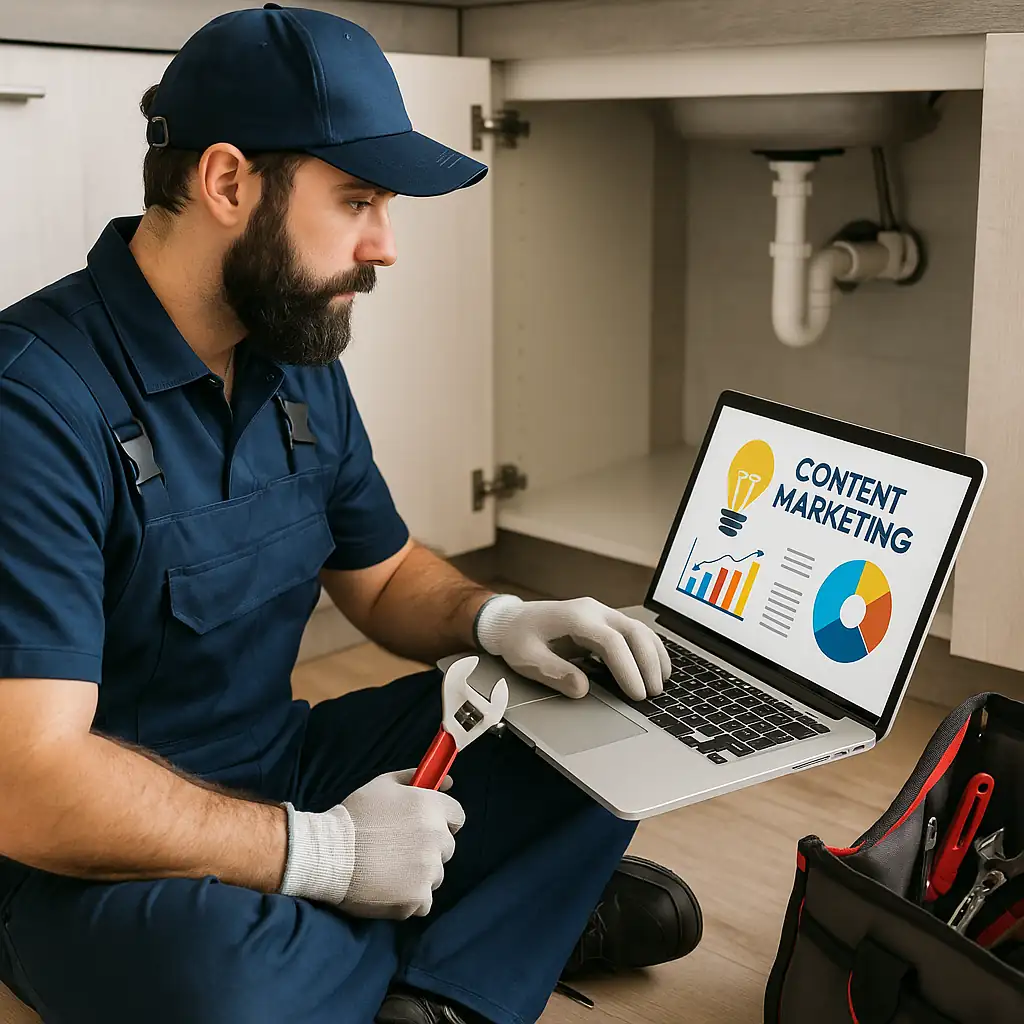
The plumbing industry is built on trust, expertise, and quick response times. But in today’s digital age, being the best plumber in town is not enough. If customers can’t find your business online, you’re losing out to competitors who may not be as skilled, but know how to market themselves.
Content marketing is the bridge between your plumbing skills and your customer’s needs. It allows you to attract, engage, and convert potential clients by providing useful and relevant information. Whether it’s a guide on unclogging a toilet, tips on preventing frozen pipes, or a video showcasing a successful bathroom renovation—strategic content helps position your company as an expert and problem-solver.
What Is Content Marketing?
Content marketing is the practice of creating and sharing valuable, informative, and consistent content to attract and retain a clearly defined audience—with the ultimate goal of driving profitable customer action. For plumbing companies, this means developing materials like:
- Blog articles on common plumbing issues
- Video tutorials and behind-the-scenes footage
- Infographics explaining plumbing systems
- FAQs about pricing, services, and emergencies
- Customer success stories and testimonials
The goal is not just to advertise, but to educate and engage. Customers are more likely to hire a plumber they’ve learned something from, especially one who explains complex issues in a way they can understand.
How Content Marketing Builds Trust and Authority
One of the biggest challenges plumbing companies face is customer skepticism. Many homeowners have had bad experiences with contractors who overcharge, show up late, or do poor work. Content marketing helps overcome this by proving your expertise upfront.
When people see that your business is generous with knowledge, they begin to view you as a trustworthy authority.
Imagine a homeowner Googling “how to fix low water pressure in my shower.” They come across a well-written blog post from your site explaining the causes, what they can try themselves, and when to call a plumber. That simple piece of content does three powerful things:
- It answers their question—building immediate credibility.
- It keeps them on your site longer—improving SEO.
- It gently positions your services as the solution—without being pushy.

Authority Means Higher Rankings
Google rewards websites that publish helpful, high-quality content. When your plumbing company consistently shares valuable insights, you begin to climb the search engine rankings.
Content is the fuel that powers your SEO engine.
Targeting keywords like “emergency plumber in [your city],” “water heater leaking fix,” or “pipe burst what to do” with detailed articles improves your chances of appearing at the top of search results when customers need you the most.
Targeting the Right Audience Through Strategic Topics
Not all content is created equal. A successful strategy begins with understanding your ideal customer. Are you focused on homeowners, landlords, commercial properties, or all of the above?
Each audience has specific concerns:
- Homeowners want maintenance tips and emergency advice.
- Landlords look for property-wide solutions and reliable service providers.
- Businesses may seek cost-effective commercial plumbing options.
Once you define your target market, you can tailor content topics to their needs. For example:
- “5 Warning Signs Your Water Heater is About to Fail” targets homeowners.
- “How to Prepare Your Plumbing Before Renting a Unit” is for landlords.
- “Why Commercial Backflow Testing Is Critical for Your Business” speaks to property managers.
Creating niche content allows you to attract the exact customers who are more likely to convert.
Visual Content: Why Videos and Photos Are Powerful for Plumbers
In an industry that’s highly physical and visual, relying solely on text-based content is a missed opportunity.
Videos and photos bring your plumbing services to life.
People want to see how you work, what your technicians look like, and what kind of jobs you’ve handled.
Here are some ideas that work especially well:
- Before-and-after project videos: Showcase transformations from old to new.
- Tool and technique demonstrations: Explain how you snake a drain or inspect a sewer line.
- Customer testimonial clips: Let happy clients speak for your business.
Visual content increases engagement, boosts time spent on your website, and improves conversion rates. It’s also more likely to be shared on social media, expanding your reach organically.

Blogging for Plumbers: A Goldmine of Long-Term Leads
One of the most effective content strategies for plumbing businesses is maintaining a consistent blog. But this isn’t about writing random tips once in a while. To drive real traffic and build authority, you need a well-planned blogging schedule.
Blogging works because it answers real customer questions in real-time.
Think about the most common inquiries your technicians hear:
- “Why is my toilet running non-stop?”
- “Is a tankless water heater better?”
- “How do I shut off the main water valve?”
Each question is an opportunity for a blog post that brings people to your website. Every post becomes a 24/7 salesperson, working while you sleep, capturing leads and building trust.
Blogs also help with:
- Targeting long-tail keywords.
- Improving internal linking.
- Creating social media and email content.
Building a Plumbing Brand Through Storytelling
While many plumbing companies focus on services, pricing, and credentials, what often sets successful businesses apart is their brand story. Customers connect with people, not just services. Telling the story of your business helps humanize your brand and makes it memorable.
Storytelling builds emotional connection.
Was your company started by a father and son? Do you specialize in helping first-time homeowners? Have you responded to major emergencies in your community?
These stories help answer a key customer question:
“Why should I choose you over the dozens of other plumbers in my area?”
Share these stories on your website’s About page, your blog, and even on social media. Highlight your values—reliability, honesty, transparency—and back them up with real stories.
Examples of Story-Driven Content:
- A blog titled: “How We Helped a Family Avoid Thousands in Water Damage”
- A video interview with your lead technician talking about his 20 years of experience
- An Instagram post about your team volunteering to fix pipes at a local shelter
People remember stories more than statistics.
Social Media Content: Amplifying Your Message
Many plumbing companies overlook social media, assuming it’s more relevant for lifestyle brands. But platforms like Facebook, Instagram, and even YouTube or TikTok can be incredibly effective when used strategically.
Why? Because your potential customers are there every day—and when plumbing problems strike, they’re more likely to recall the company they’ve already seen online.
Social media gives your content a second life.
A blog post doesn’t just sit on your website—it becomes a Facebook update, a quote for a Tweet, or a script for a YouTube short. With a consistent content calendar, you can maintain visibility and build familiarity.
Here’s what works well for plumbers:
- Short videos with maintenance tips (e.g., “How to prevent drain clogs”)
- Time-lapse videos of major jobs
- FAQs answered in fun Reels or Stories
- Quick success snapshots: “We helped this homeowner fix a burst pipe in 1 hour!”
Pro tip: Don’t overthink production quality. Authentic, helpful videos often outperform polished commercials.

Email Marketing: The Forgotten Goldmine
While everyone talks about social media, email remains one of the highest-converting channels—especially for local service businesses like plumbing.
You don’t need a huge list. Even a few hundred customers and leads can turn into consistent revenue when you use email correctly.
What to send your email list:
- Seasonal plumbing checklists (e.g., “Winter Plumbing Prep Guide”)
- Service reminders (e.g., “Time for Your Annual Water Heater Flush?”)
- Exclusive offers for subscribers
- Educational content: “How to avoid mold after a leak”
The key is to be helpful, not pushy. Educate, inform, and occasionally offer a promotion. This keeps your business top-of-mind without being annoying.
And unlike social media, you own your email list.
No algorithm can prevent your message from reaching your audience.
Optimizing Your Website for Content Performance
All your content efforts—blogs, videos, social posts—should ultimately lead people back to your website. That’s where conversions happen. So it’s crucial that your website is optimized not just for SEO, but also for user experience.
Here’s what to include:
- Clear Call-to-Actions (CTAs):
After reading an article or watching a video, what should the visitor do next? Make it clear. Whether it’s “Call Now,” “Request an Estimate,” or “Book Online,” don’t make them guess. - Mobile Responsiveness:
Most users will visit your site on their phones. Make sure it loads quickly, looks clean, and is easy to navigate on mobile. - Structured Content:
Break up your pages with headlines, bolded phrases, and internal links. This makes your content easier to scan and improves engagement. - Testimonials and Trust Signals:
After a helpful blog post, show a real client review or a badge from the Better Business Bureau. These add credibility and move visitors toward hiring you.

Local SEO + Content: A Perfect Match
You’re not trying to rank nationally—you want customers in your service area. That’s why local SEO and content marketing should work hand in hand.
By creating content focused on specific neighborhoods or regional issues, you show up in local searches more often. For example:
“Best Water-Saving Fixtures for Homes in Phoenix”
“Winter Plumbing Tips for Minneapolis Residents”
“Why Miami Condos Need Backflow Prevention”
Also, be sure to:
Create service area pages with localized content
Use your city or region in blog post titles and meta descriptions
Claim and optimize your Google Business Profile (formerly Google My Business)
Localized content helps build familiarity and trust with homeowners who prefer hiring someone who knows the area. Including details about local events, weather, or building styles can make your content stand out as both relevant and relatable.
Over time, this localized approach not only boosts your visibility on Google Maps and search results, but also positions your brand as the neighborhood expert—someone who truly understands the needs of the community.
Turning Customer Questions into Content
If you’re ever stuck on what kind of content to create, just ask your technicians.
Every week, they’re answering the same questions from customers. Use those conversations to drive your content calendar.
For example:
Q: “Should I repair or replace my water heater?”
A: Write a blog titled “Repair vs. Replace: What to Do When Your Water Heater Acts Up.”Q: “Why is my toilet making that noise after flushing?”
A: Create a YouTube video or Facebook reel explaining the likely causes.Q: “How do I shut off the main water valve?”
A: Make an infographic and pin it to your website’s homepage.
If one person asked, hundreds more are googling it.
This strategy ensures that your content is answering real-world concerns and not just abstract topics. Plus, it shows customers that you’re listening and responsive, which builds stronger brand loyalty.
Incorporating your technicians’ voices—maybe even featuring them in content—adds authenticity and humanizes your brand, making it more approachable and credible.

From Content to Conversion: Turning Viewers into Customers
Creating helpful content is only half the equation. The ultimate goal is to turn readers, viewers, and followers into paying customers. This process is called content conversion, and it depends on two main elements: trust and direction.
When a homeowner reads your blog on “How to Prevent Frozen Pipes,” they now see you as knowledgeable. But they still need a gentle nudge to take action. That’s where conversion-focused elements come into play:
A compelling call-to-action (CTA):
“Need help winterizing your pipes? Call us today for a home inspection.”A lead capture form:
Offer something in return, like a free checklist or downloadable guide, in exchange for their email.A booking system or contact button:
Make it easy for users to reach you. A sticky “Schedule Service” button or a chatbot can dramatically increase conversions.
You should also make your CTAs context-specific and aligned with the intent of the content. For example, a CTA on a blog about clogged drains should link to your drain cleaning service, not a generic homepage.
Testing different CTAs, button placements, and form formats can help you optimize your strategy. What works for one user may not work for another—small tweaks can lead to big results.
Measuring the Success of Your Content Marketing
You can’t improve what you don’t measure. One of the most powerful aspects of digital marketing is the ability to track every click, view, and conversion.
For plumbing companies, these are the key content metrics to monitor:
Website Traffic: Are your blog posts and landing pages bringing in new visitors?
Time on Page: Are people reading your content, or leaving after a few seconds?
Click-Through Rate (CTR): Are your calls to action being clicked?
Lead Generation: Are you collecting emails or phone numbers through forms?
Conversion Rate: How many visitors end up calling, booking, or filling out your contact form?
You can use free tools like Google Analytics, Google Search Console, or Hotjar to understand user behavior and refine your strategy.
Analyzing performance helps you spot patterns—maybe certain topics perform better than others, or certain pages drive more conversions.
By measuring your progress over time, you’ll see what delivers the best return on investment (ROI). That data-driven approach ensures your content marketing grows smarter and more effective with every post.

Case Study: How One Plumbing Business Doubled Their Leads
Let’s look at a practical example.
Joe’s Plumbing & Heating was a small, family-run plumbing company in a competitive suburban market. They had a basic website and relied on word-of-mouth referrals. Business was steady but had plateaued.
They decided to invest in content marketing. Here’s what they did:
Published weekly blog posts targeting local keywords and common plumbing questions.
Created “how-to” videos explaining simple fixes, and posted them on YouTube and Facebook.
Revamped their website to include more service pages, reviews, and CTAs.
Built an email list and sent monthly newsletters with seasonal tips and promotions.
Collected common customer questions from technicians and turned them into new content.
Within 6 months:
Website traffic increased by 250%
Phone calls from organic search doubled
Top 3 local results for “emergency plumber near me”
Team grew from 3 to 5 technicians
They didn’t rely on tricks or hacks—just helpful content that answered real questions. Their consistency paid off, and the return on investment was clear.
This case proves that small, strategic actions can scale a plumbing business. It also shows that content marketing levels the playing field, even for local companies with modest budgets.